 Blog
Blog Where Can I Buy Quick Fix Synthetic Urine?
ONE OF THE MOST COMMON QUESTIONS WE RECEIVE HERE AT QUICK FIX: WHERE CAN I BUY A QUICK FIX SYNTHETIC IN A STORE NEAR ME?…


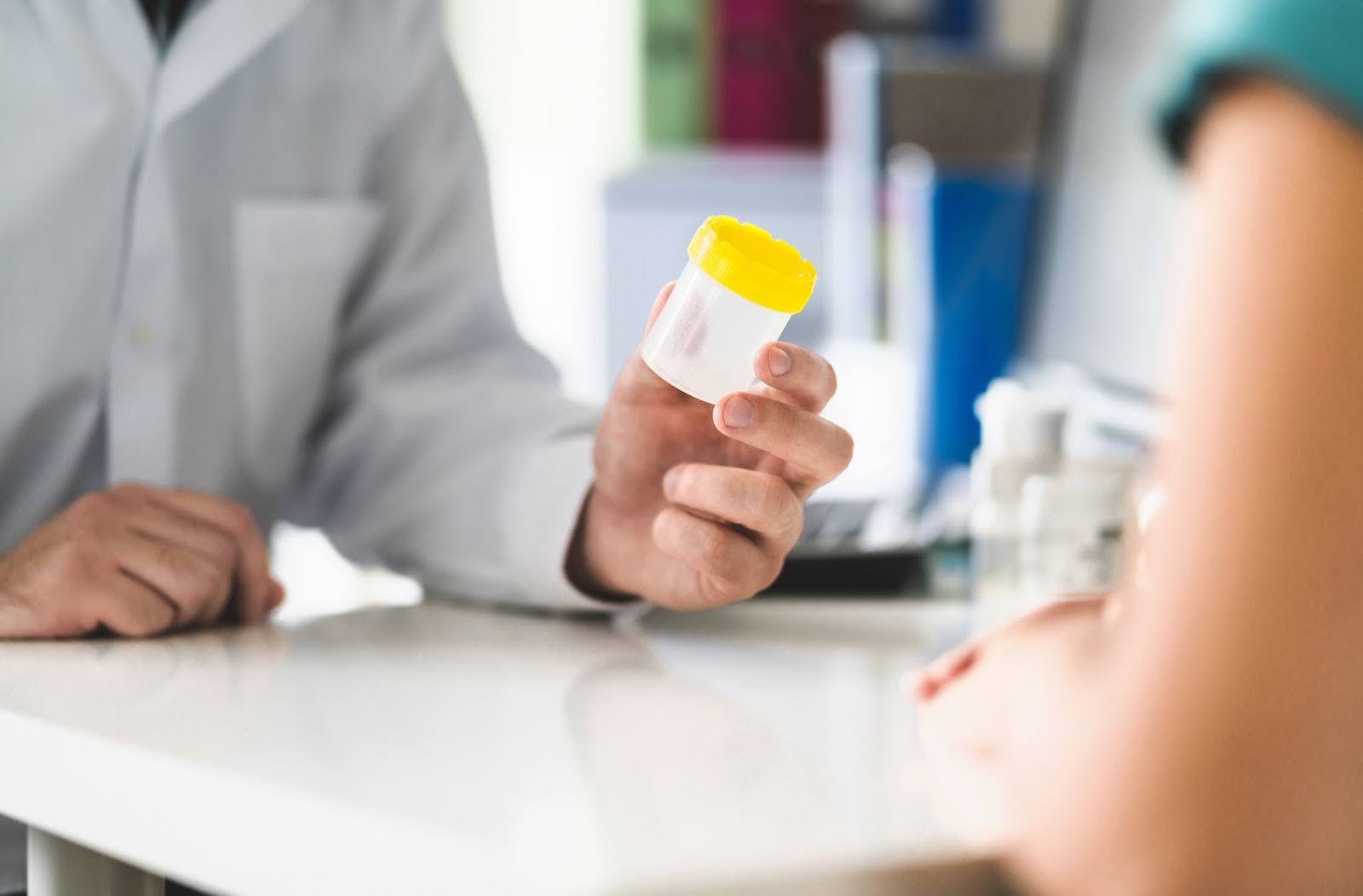
Drug tests are routine checks used by employers, healthcare providers, and insurance companies to confirm the presence (or absence) of certain substances. Most urine drug tests take only a few minutes from start to finish, although certified lab results may take 1–3 business days. Preparing is simple: bring proper ID, follow instructions from the collection site, avoid excessive fluids, and give yourself enough time to arrive without stress.
Being asked to complete a drug test can make even the most steely-nerved feel somewhat tense, despite having done nothing wrong. And that’s a perfectly normal emotion to have. We wouldn’t blame anyone for feeling a little unnerved.
But with modern drug screening being predictable, controlled, and designed to be as simple as possible, there really is very little, if anything, to fear. Once you are fully up to speed with what happens during a drug screen, the whole experience becomes far less intimidating.
We thought a quick heads up might help reassure you – in the form of this guide – which explains the drug screening meaning, how the tests work, and what to do before a drug test so you feel calm, confident, and totally unflappable the moment you step through the door with your sample.
Ok, let’s get the raw basics out of the way.
A drug test is a screening used to identify certain substances or their metabolites in your system. Employers rely on them to meet workplace policies, healthcare providers use them to inform treatment, while insurers may request them as part of underwriting.
The drug screening, in literal terms, is just an evidence-based method for verifying something specific, usually in the form of a blood or urine test.
While every panel is slightly different, most drug tests check for, shall we say, the usual suspects, such as:
Some tests screen for more groups, some fewer. But the broad principle is always the same: the lab is looking for metabolites tied to certain substances.
Different professions and situations call for different methods, but for the most part, here’s how each one generally works:
The standard for workplace drug testing. It’s quick, easy, and detects a broad range of substances. Results usually return within 1–3 days.
Non-invasive and often used for rapid screening. Detection windows are shorter than urine, but collection is simple.
Used less frequently because it detects only recent use and is more expensive to administer.
Provides a long detection window – up to 90 days. This type of test is far less common, but can sometimes be used in specialized roles.
Across all formats, the underlying question remains:
Drug tests look for metabolites, the small chemical traces your body leaves behind after using a substance. Once you provide a sample, the lab runs it through routine checks, including temperature, pH, and specific gravity, before moving into more detailed analysis.\
Most labs check for:
All of this happens fairly quickly, using equipment designed to pick up even small changes in the sample.
If you’re looking for a simple way to keep your synthetic urine at the right temperature during preparation, we have remarkably handy Quick Fix Temperature Strips that make the process easier and generally more reliable on test day.
Given that urine collection is the most widely used drug testing method, it often helps to know the exact order of play. Here’s the typical sequence from the moment you walk in to the moment you leave.
You start by presenting your ID and completing the required forms. This is the drug test check phase: verifying your identity, confirming the reason for the test, and ensuring everything matches your employer’s request. If you take prescription medications, there’s usually a space to list them, too.
A technician will ask you to empty your pockets and remove unnecessary items. Yes, it seems a little jailhouse in nature, it’s just standard procedure. You will then be given a collection cup with a temperature-sensitive label. They will then explain the rules. These include (but are not limited to) not washing hands beforehand, not flushing the toilet, and a required sample volume (usually at least two ounces).
Everything is structured to maintain a chain of custody, meaning the sample is tracked securely from the moment it leaves your hands to the moment it reaches the lab.
The technician will confirm the temperature is within range, seal the cup in front of you, and complete the paperwork. You will then be free to leave or return to the waiting area.
All in all, the entire process is quite simple, really.
Don’t worry. A urine drug test is one of the fastest procedures you are likely to encounter in any clinical setting.
The approximate timelines usually unfold as follows:
It used to be far slower than this (barely a couple of decades ago, the whole process might have taken a couple of weeks or more), but rapid systems are becoming far more common these days because they speed up hiring decisions and reduce delays.
Try not to overthink this part, as many seem to do. Preparing well doesn’t require changing your routine; it simply means removing uncertainty and avoiding needless mistakes.
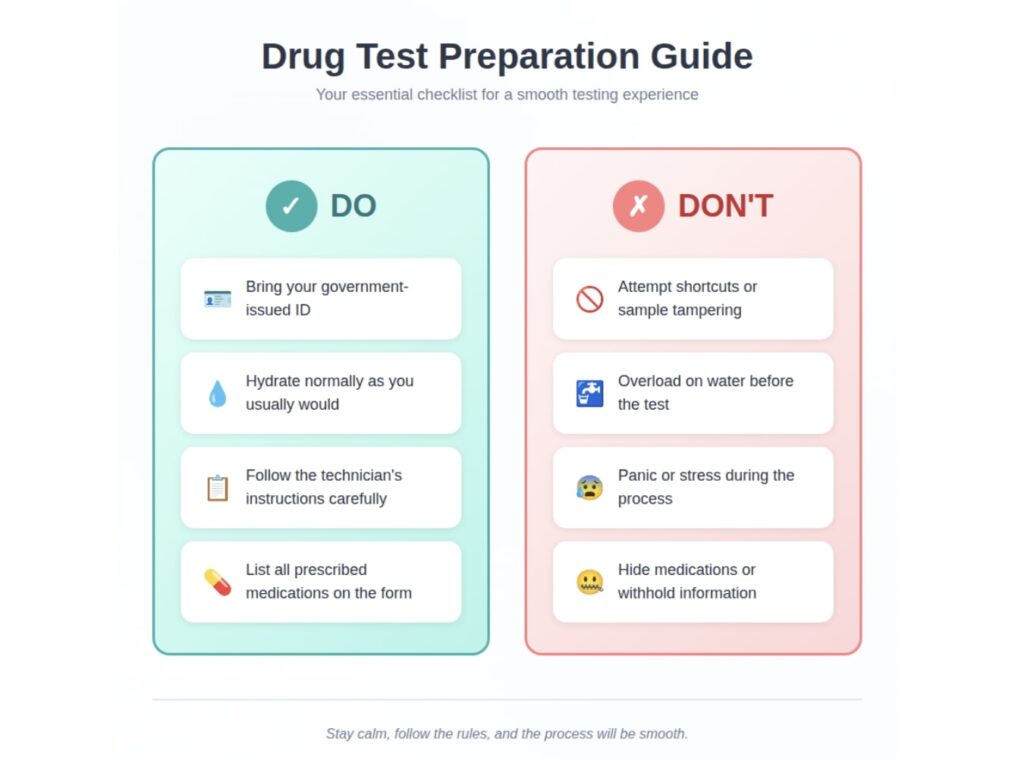
Your government-issued ID is a deal breaker, and you will need any documents provided by your employer or clinic.
Give yourself time to check in comfortably, just to mitigate stress, if nothing else.
Drink water as you normally would. Too much liquid right before the test can dilute your sample and may require a retest.
Remember, the technician’s guidance exists to keep the process consistent and fair.
Other than alcohol, there are a few different drinks to avoid before a drug test, such as energy drinks or overindulging in caffeine.
Some habits cause delays, retests, or unnecessary complications.
Adding substances, using shortcuts, or trying online “tricks” can invalidate the sample immediately.
Dilution can lead to inconclusive results.
If you take prescribed medication, list it on the form. It helps the lab interpret findings accurately.
The procedure is the same every day. Relax and let the routine take its course.
Many employers now use eCup or eScreen technology to obtain instant results. Unfamiliar? You’re not alone. Essentially, these systems automate much of the process by utilizing built-in sensors to automatically read and log key checks, thereby reducing human error and enabling negative screens to be reported within minutes.
From your perspective, nothing changes, as you still provide the sample the same way. The difference happens behind the scenes, where the device scans the cup and processes results digitally. It’s efficient, reliable, and ideal for time-sensitive hiring.
Once you know how drug testing works, what labs look for, and how long everything takes, the entire experience hopefully seems less intimidating. Just walk in with your ID, follow the technician’s instructions, avoid overthinking the process, and hydrate the same way you do every day.
Good luck, and remember – don’t overthink the process. It’s all quite simple, really.
Labs analyze your sample for metabolites linked to specific substance categories. It’s a simple, structured, automated process.
Panels vary, but they commonly include cannabis, opioids, cocaine, amphetamines, benzodiazepines, and sometimes alcohol or nicotine.
Collection is nice and quick. Most lab-processed results return in 1–3 business days.
Avoid excessive water, avoid tampering, and follow instructions exactly.
Most follow similar procedures, but the exact panel and method depend on company policy.
This guide is for educational purposes. Quick Fix products are intended for simulation, calibration, and novelty use only. Nothing in this article should be interpreted as guidance for unlawful use.
 Blog
Blog ONE OF THE MOST COMMON QUESTIONS WE RECEIVE HERE AT QUICK FIX: WHERE CAN I BUY A QUICK FIX SYNTHETIC IN A STORE NEAR ME?…
 Blog
Blog How to use your Quick Fix urine Upon reading synthetic urine reviews and stories of how people went into the lab and delivered a synthetic…
 Blog
Blog Gas chromatography-mass spectrometry is a means of analyzing samples to identify individual substances using the features of gas-liquid chromatography as well as mass spectrometry.…


