 Blog
Blog Where Can I Buy Quick Fix Synthetic Urine?
ONE OF THE MOST COMMON QUESTIONS WE RECEIVE HERE AT QUICK FIX: WHERE CAN I BUY A QUICK FIX SYNTHETIC IN A STORE NEAR ME?…



TL;DR: In a microwave, Quick Fix needs about 10 seconds on full power with the cap off. With the heating pad, allow 45-60 minutes. The difference is not really about speed; the microwave gets the bottle warm and then abandons it, whereas the pad keeps supplying heat for roughly 8 to 10 hours. For any lawful research or calibration work in which the sample must remain within range for some time, the pad is a good option.
Ten seconds against most of an hour looks like an absurd gap until you notice the two methods are being deployed for completely different jobs. But by its very nature, a microwave behaves like a kettle. It is excellent at getting something hot and hopeless at keeping it there once you switch it off. The heating pad is closer to a slow cooker, taking its time to reach temperature and then holding the line for the rest of the day.
So the honest answer to how long does Quick Fix take to heat up is that it depends on whether you care more about getting warm quickly or staying warm afterward. Either way, this blog post covers all options.
Anyone who has stood watching the last three seconds tick down on a microwave display will find 45 minutes almost geological in scale, by comparison. But the choice has far less to do with patience than with what you need the heat to do after it arrives. Here’s a handy chart to help you weigh one method against the other at a glance.
So, ten seconds is your microwave figure for how long it takes for Quick Fix to heat up. Give the pad three-quarters of an hour if you want it to warm unassisted. Everything else is a matter of matching the method to your timing.
There is one thing worth mentioning regarding the discrepancy between the number on the bottle and the number in the regulations, though. Quick Fix treats a green temperature strip reading of roughly 94-99°F as its target, while federal workplace collection rules accept readings from 90-100°F.¹ The strip is the stricter of the two, which is no bad thing to have on your side.
For lawful lab or calibration use, the microwave is the obvious pick when you need Quick Fix warm this minute. The routine is short: just take the cap off, heat on full power for about 10 seconds, replace the cap, and read the strip. Simple, just as it was designed to be.
One quick caveat, though. Full power on a microwave isn’t a precise scientific quantity, so treat 10 seconds as a starting point only. If the strip shows nothing, the liquid has overshot and needs a moment to cool. If it reads below range, another five seconds usually settles it.
For the complete step sequence, including strip colors and what to do when a reading looks off, our step-by-step guide to heating Quick Fix in a microwave covers the preparation methods.
Spectrum Labs designed the pad to work with the Quick Fix bottle and to hold roughly 90 to 100°F for up to 10 hours. Starting from ordinary room temperature, budget 45 to 60 minutes for the pad to bring the sample up on its own.
To activate it, just give the pad a good 15-second shake, attach it to the bottle with the supplied rubber band (with the strip facing outward so you can actually see it), and wait for a green or tan-and-blue in-range reading. That setup makes far more sense during a calibration session where the liquid needs to stay warm for an extended stretch, and it spares you the mild chore of lingering beside a microwave.
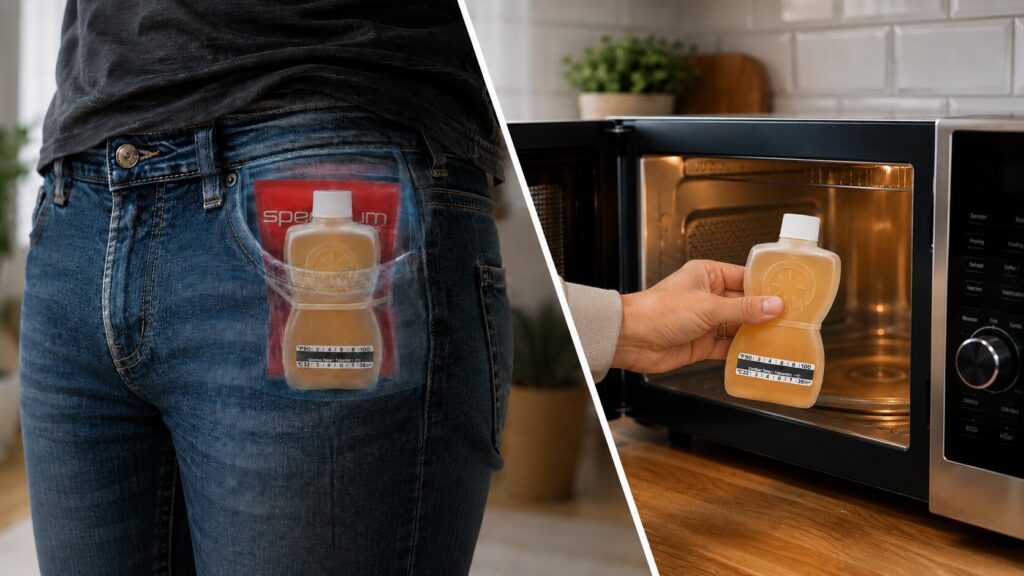
If you need it warm right now for legitimate lab work, the microwave wins easily; ten seconds is hard to argue with when the alternative is occupying the next three-quarters of an hour. By the same token, the heating pad is useful when your timing is uncertain, holding temperature for up to 10 hours, so you are not tied to a narrow window.
Nothing stops you from doing both, of course: microwave it first for a quick warm-up, then use the heating pad to keep it warm.
Body heat alone is the one thing you should avoid, since it varies far too much from person to person to pin down a reliable time. For calibration and research runs, the pad is also a closer stand-in for how the kit behaves in the field, and the Quick Fix Heating Pad is built specifically for the 90-100°F range.
If you need Quick Fix warm in a hurry, the microwave gets you there in about 10 seconds. If you have 45 to 60 minutes, the heating pad works more gradually and then keeps the sample warm for something like 8 to 10 hours afterward.
But which one is the better option really boils down to a single question: how long does the bottle need to stay warm? A microwave suits quick laboratory preparation and little else. For a longer research or calibration session, the pad offers far better temperature control, and for a practice run, it provides a more realistic rehearsal of the real thing.
If you are stocking up either way, a spare pad certainly never goes amiss, and the Quick Fix 6.4 Plus Synthetic Urine kits include one as standard.
Yes, and it is arguably the most flexible approach going. The microwave brings the sample up to temperature straight away, and the pad then takes over to hold it there for the next several hours. It is a good option when you need heat immediately, but also expect a longer wait before the sample is used.
There is no equally quick method that offers the same temperature control. Passive body warmth is slower and leans heavily on your surroundings, so for research or calibration work it is better to allow enough time for the supplied pad to do its job properly rather than rushing an unreliable shortcut.
It can. A colder room pulls heat away from the bottle faster than the pad can add it, so the 45 to 60 minute estimate may stretch by 15 to 20 minutes in genuinely cold conditions. Wearing the kit close to your body helps, and as always, the temperature strip is a better guide than the elapsed time.
1. Under 49 CFR §40.65, federal workplace collection rules accept specimen temperatures of 90 to 100°F (32 to 38°C) and require the temperature to be read no later than four minutes after the sample is presented. Quick Fix uses a narrower green display band on its own temperature strip.
Disclaimer: This content is for informational and educational purposes only. Quick Fix Synthetic does not condone or encourage the use of our products to defraud legally mandated drug tests. Please consult your local and state laws before use.
 Blog
Blog ONE OF THE MOST COMMON QUESTIONS WE RECEIVE HERE AT QUICK FIX: WHERE CAN I BUY A QUICK FIX SYNTHETIC IN A STORE NEAR ME?…
 Blog
Blog How to use your Quick Fix urine Upon reading synthetic urine reviews and stories of how people went into the lab and delivered a synthetic…
 Blog
Blog Gas chromatography-mass spectrometry is a means of analyzing samples to identify individual substances using the features of gas-liquid chromatography as well as mass spectrometry.…


