 Blog
Blog Where Can I Buy Quick Fix Synthetic Urine?
ONE OF THE MOST COMMON QUESTIONS WE RECEIVE HERE AT QUICK FIX: WHERE CAN I BUY A QUICK FIX SYNTHETIC IN A STORE NEAR ME?…


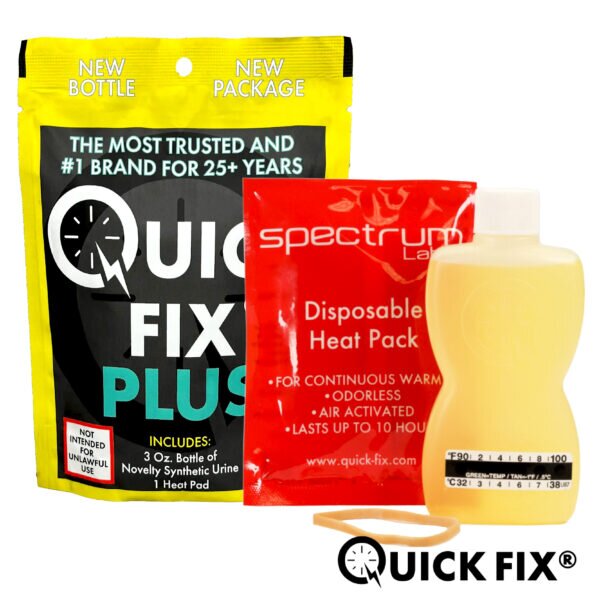
TL;DR: Yes, Quick Fix has failed in documented cases. Many reported failures trace back to temperature submission outside the valid range, expired product, counterfeit kits, or advanced GC-MS testing rather than a formulation problem.
When an authentic, in-date kit is submitted at the correct temperature in a standard immunoassay context, many user reports describe successful outcomes.
Yes, Quick Fix has failed. That’s the honest answer, and any article that tells you otherwise is trying to sell you something harder than synthetic urine.
What the record actually shows is more useful than a blanket pass or fail verdict: in many cases, failures cluster around specific, identifiable causes.
The question isn’t whether failure is theoretically possible — it is — but whether the failure that happens is a product failure or something else. In many reported cases, it appears to be something else.
Quick Fix has failed in documented cases. The brand has been in the market for more than two decades, which is a notable longevity.
However, longevity is not the same as a perfect record, and no synthetic urine product can claim a 100% pass rate across every testing context, every lab, and every user who has ever handled it.
Many reported cases in which Quick Fix has failed (or any synthetic urine product has failed) point to temperature, aging, counterfeits, or testing conditions that go beyond a standard immunoassay screen. That pattern appears frequently enough in user reports to warrant detailed examination, even if the data behind it are largely anecdotal rather than independently compiled.
Labs check the temperature before they check anything else. A sample that reads outside the 90–100°F (32–38°C) valid range (the window established in federal workplace testing guidelines as indicative of fresh human output) is flagged immediately, regardless of how chemically correct the formulation is.
The most pristine synthetic urine in the world fails a temperature check just as definitively as tap water would.
This is a common origin of reported Quick Fix failures. The heating pad wasn’t activated long enough. The sample cooled during transport. The temperature strip was misread. Someone checked once, thought it was fine, and waited fifteen minutes too long.
Temperature management is a time-sensitive, hands-on process. Handle it once and assume it’s done, and the window can close before you reach the collection point.
Synthetic urine is a chemically balanced solution. The key markers (creatinine, urea, pH, specific gravity) need to fall within human reference ranges to pass validity testing.
Over time, and especially once a kit is past its expiration date, that balance can change. Creatinine degrades. pH drifts. Specific gravity moves. A sample that was chemically correct when it left the production line may not be chemically correct two years later.
This failure mode is largely avoidable with basic due diligence. However, due to storage conditions, manufacturing variation, and factors outside the user’s control the expiration date alone isn’t an absolute guarantee of formula integrity.
Checking the date before purchase, before storage, and again before use is the minimum. If the kit has been sitting in a drawer since before your last oil change, that’s useful information to have sooner rather than later.
Some negative reviews and reported failures in the Quick Fix space appear not to involve authentic Quick Fix at all — rather, products that look like Quick Fix but come from unauthorized sources with inferior or incorrect formulations.
The precise proportion of failures attributable to counterfeits isn’t publicly quantified, but counterfeit health and personal care products are a documented concern across consumer categories, and the risk of encountering one is real when buying through unverified channels.
Counterfeits are typically not validated by the original manufacturer and may be missing key validity markers, contain compounds that trigger flags, or carry pH and creatinine values that no human body has ever produced.
The batch number verification system exists for this reason. Verified user accounts consistently point to purchase source as a meaningful variable. Buying through unauthorized third-party marketplaces introduces a product-integrity risk that lies entirely outside the formulation itself.
Standard immunoassay drug screens (the kind used in many routine pre-employment testing programs) are designed to detect drug metabolites.
They validate a sample’s physical and chemical markers (temperature, creatinine, pH, specific gravity) to confirm that it appears to be urine. What they aren’t designed to do is determine whether the urine is synthetic. That’s a different analytical question requiring a different tool.
Gas chromatography-mass spectrometry, GC-MS, can characterize a sample’s molecular profile in far more detail than immunoassay and may allow detection of atypical or synthetic formulations in some contexts.
Many routine pre-employment screens do not run it as a first-pass procedure. It’s more commonly associated with confirmatory testing on a flagged immunoassay result, forensic analysis, or regulated programs where DOT guidelines apply.
But in contexts where it is deployed earlier in the process (certain federal contractor programs, high-security testing environments, and forensic contexts are plausibly among them, though specific policy documentation varies), the detection risk increases in ways that go beyond what standard validity testing can catch.
That’s not a Quick Fix problem specifically, but a ceiling condition for the category as a whole.
A quality tire doesn’t fail because it’s a bad tire — it fails because it was underinflated or driven over a nail.
Many reported Quick Fix failures follow a similar pattern: in case after case, the failed variable wasn’t the formula.
The cap was left on during microwave heating. The bottle was not shaken before submission, so no foam forms, and the sample looks flat. The temperature strip was placed incorrectly, so the reading is ambiguous. The seal was not checked.
These aren’t product failures. They’re preparation failures, and preparation is the one variable entirely within the user’s control.
The instructions exist for a reason. Following them exactly every time, including during a practice run, is the clearest line between a submission that goes smoothly and one that results in a frustrated review.
Negative reviews of Quick Fix exist, and acknowledging them is just reading the internet honestly. The more instructive exercise is looking at what those reviews describe: where people bought the product, how they heated it, whether they checked the temperature, and when they purchased it.
Many reported failures, when read in detail, point to one of the five causes already covered here. Temperature, expiration, counterfeit source, and procedural error appear as common themes in many reported failures.
There are genuine failures in the reported record, too — cases apparently involving advanced testing panels or higher-scrutiny environments, though concrete documentation of specific contexts is sparse.
These represent the realistic ceiling condition for the product: a lab deploying more sophisticated analysis than a standard immunoassay screen presents a materially different environment, and treating both situations as equivalent risk is a mistake.
Quick Fix has failed. That’s documented, that’s honest, and that’s the only place a credible answer to this question can start. But the failure record, read carefully, tells a more specific story than “the product sometimes doesn’t work.”
Many failures appear traceable to temperature, expiration, counterfeit product, or procedural missteps, and these causes exist independently of whether the formula itself is sound. That pattern is consistent across user reports, even if the underlying data are anecdotal rather than independently verified.
Temperature management, expiration verification, purchase source, and careful adherence to preparation instructions aren’t incidental details. They’re the variables that separate many failure cases from successes in reported accounts.
The product is one piece. Understanding where it can go wrong is the rest of it.
The differentiating factor is testing methodology rather than any specific facility name. Labs that deploy more sophisticated analytical methods (including GC-MS analysis earlier in the process rather than only as a confirmatory step) present a higher detection risk for any synthetic urine product.
High-security testing environments, certain federal contractor programs, and forensic contexts are plausibly among those more likely to involve advanced analysis, though specific policies vary by program and employer.
Many routine pre-employment screenings begin with immunoassay testing, but actual practice and detection risk can vary by lab and employer.
No. The formulation in Quick Fix 6.4 is identical across both sizes, the only difference being the quantity available. Labs require a minimum volume (typically 30mL for a standard screen), and both kit sizes meet that threshold.
Volume alone has no bearing on whether the sample’s chemical composition passes validity testing. The choice between sizes is logistical, not a reliability decision.
We were unable to locate any publicly documented recall associated with Quick Fix. Our batch verification system gives users a way to confirm their specific kit against current production records — its existence is documented, though its efficacy in catching all possible production issues is not independently validated.
Verifying a batch number before use remains the most direct step a user can take to confirm their kit’s authenticity and current status.
In many regulated workplace testing programs, a failed or flagged result is reviewed through a Medical Review Officer (MRO) process, but the exact procedures vary significantly by employer, testing program, and jurisdiction, and not all employment testing contexts involve MRO review.
Depending on the specific flag reason (temperature out of range, invalid creatinine, confirmed positive), the MRO may allow a re-collection under direct observation.
If a result is disputed, requesting the specific reason for the flag gives a clearer picture of what actually happened and what (if any) recourse exists under the applicable employer policy or applicable law.
Disclaimer: This content is for informational and educational purposes only. Quick Fix Synthetic does not condone or encourage the use of our products to defraud legally mandated drug tests. Please consult your local and state laws before use.
 Blog
Blog ONE OF THE MOST COMMON QUESTIONS WE RECEIVE HERE AT QUICK FIX: WHERE CAN I BUY A QUICK FIX SYNTHETIC IN A STORE NEAR ME?…
 Blog
Blog How to use your Quick Fix urine Upon reading synthetic urine reviews and stories of how people went into the lab and delivered a synthetic…
 Blog
Blog Gas chromatography-mass spectrometry is a means of analyzing samples to identify individual substances using the features of gas-liquid chromatography as well as mass spectrometry.…


