 Blog
Blog
Where Can I Buy Quick Fix Synthetic Urine?
ONE OF THE MOST COMMON QUESTIONS WE RECEIVE HERE AT QUICK FIX: WHERE CAN I BUY A QUICK FIX SYNTHETIC IN A STORE NEAR ME?…

TL;DR: Collect a midstream urine sample, and dip the strip for 10–15 seconds without going past the MAX line. Lay it flat, wait five minutes, and read the result. Two lines equals negative, but one line, the control line only, equals positive. Whatever you do, do not read the strip after ten minutes, because the chemistry might start misreporting.
If you have ever bought a home drug test kit and found yourself squinting at a plastic strip trying to work out whether a faint pink line means good news or a stuttering, panic-driven conversation with Sandra from HR, this article might serve you well.
We feel like a quick guide is in order, because many people get this wrong on the first go, largely because home drug test kits operate on a principle that often feels opposite to what feels natural.
So, what we have here is a complete guide to using a home drug test kit properly, reading the result without giving yourself an unnecessary nervous breakdown, and knowing what steps to take next.
Immunoassay: The antibody-based detection method used in almost every home strip and most workplace initial screenings. The strip does not measure the amount of a substance present; it checks whether a defined threshold has been exceeded.
Cutoff concentration: The minimum quantity of a substance required to trigger a positive result. Below the cutoff, the strip reads negative even if trace amounts are technically present. This is by design.
Chain of custody: The documented handling process that gives an official test its legal weight, including who touched the sample, when, and where. Home kits do not have this, which is precisely why they are screening tools rather than admissible evidence.
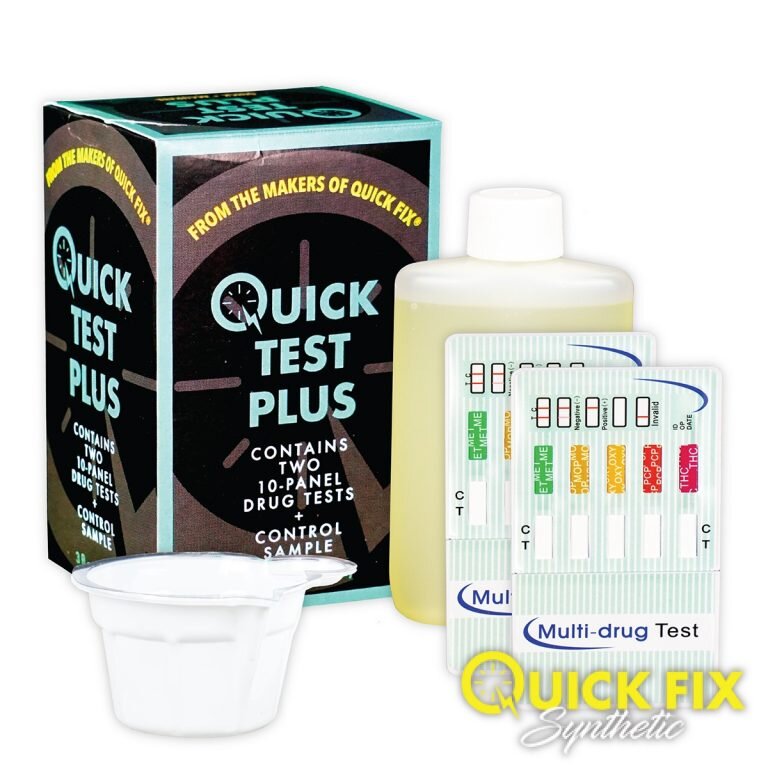
Before you get to the dipping and squinting, it helps to know what you actually have in your hands. A typical home drug test kit, like the Quick Test Plus, contains two 10-panel test strips, two collection cups, and a printed instruction sheet.
The strips themselves use immunoassay technology, the same fundamental method deployed in most workplace initial screenings. They cover a ten-substance panel, including THC, AMP, BAR, COC, MDMA, BZO, MET, OXY, MOP, and PCP.
Results appear within five minutes. The kit is a genuine, functional urine drug test kit, engineered to give a reader an accurate preview of what a certified lab would find, and the two strips per kit mean you have a spare if the first one produces a nonsensical result.
Now for the counterintuitive part of this guide (the part that tends to trip up some people).
A home drug test kit strip carries two potential lines. The control line (C) simply tells you the strip is working. The test line (T) is the one that matters, and it behaves in a way that catches almost everyone out on their first attempt:
But what are we referring to when we say counterintuitive?
The two-lines-equals-negative rule sounds a little backward, but there is a reason for it. The strip is coated with antibodies that react to the drug metabolite. When the substance is present in the sample, it binds to those antibodies first and blocks the test line from forming. When the substance is absent, the antibodies have nothing to bind to, and the test line appears.
So, presence hides the line, while absence reveals it.
A negative result means each substance on the panel came in below its cutoff. That is genuinely good news, but it is not a cast-iron guarantee of the same outcome on an official test. Timing, individual metabolism, and hydration all shift the numbers a little.
A positive result on a home drug test kit is not something to act on by itself. Confirm with a certified laboratory using gas chromatography-mass spectrometry before making any employment, legal, or medical decision. An invalid result – no lines visible at all – means the test simply did not run. Use the second strip. If that one also comes back blank, the issue is likely kit quality, sample temperature, or expired strips.
If you were using the kit to pass drug test kit protocols as a pre-screen before an official test, take the same approach: a home negative is encouraging; a home positive is a warning worth acting on before, not after, the real thing.
Home kits are stocked at many pharmacies and online retailers, but if you want a kit that matches workplace cutoffs and comes from a manufacturer with a decade-plus track record, the Quick Test Plus is available directly through the Quick Fix site.
In full transparency, you don’t really need this guide. Aside from straining into a cup, using a home drug test kit is pretty much effortless. These kits are designed with simplicity in mind because the last thing you need when stressing about an upcoming test is a set of instructions that ultimately blows your mind.
To that end, the process is simple. What really matters is knowing how much weight to place on the result.
A negative reading is worth trusting, while a positive reading deserves a proper lab before anyone acts on it, since lawful prescriptions often produce the same result as unlawful habits. An invalid strip means the test didn’t run properly, which is exactly why there is a second strip in the box. Simple.
No, standard immunoassay strips do not screen for ethanol; alcohol requires a different test type (a breathalyzer or a specific EtG urine test). If alcohol screening is what you need, buy a kit designed for that specific purpose rather than assuming a 10-panel drug kit will cover it.
Yes, morning first-void urine is the most concentrated sample you will produce all day, which means substances that would sit below the cutoff in a later, more dilute sample can register as positive in the morning. For pre-screening purposes, testing morning urine gives you the earliest possible warning; for a truer picture of average concentration, mid-morning is often more representative.
You can, and the result will be negative on every panel, because a properly formulated synthetic sample contains no drug metabolites. That does not tell you anything about whether the sample would pass a laboratory’s validity check, though. Validity screens for temperature, creatinine, specific gravity, and pH – none of which are evaluated by a standard immunoassay strip.
A home kit gives you a result in 5 minutes. An initial lab immunoassay screen typically returns in 24–48 hours. Confirmatory GC-MS testing usually takes 3–5 business days. The home kit is faster, cheaper, and less definitive. That is the entire trade-off.
Not reliably. The reagents on the strip degrade over time, particularly in warm or humid conditions. An expired strip is more likely to produce an invalid result or a false negative than a false positive. Check the expiry date on the pouch before use, and if the kit has been sitting in a bathroom cabinet for two years, spend the small amount required to get a fresh one.
Disclaimer: This content is for informational and educational purposes only. Quick Fix Synthetic does not condone or encourage the use of our products to defraud legally mandated drug tests. Please consult your local and state laws before use.
[^1]: Timing is not a suggestion in immunoassay testing. Reading the strip too early can yield false negatives because the reagent has not fully migrated; reading too late can allow continued line development, which can produce misleading results.
[^2]: The immunoassay competition principle works by having drug-metabolite antibodies compete for binding sites. When the target substance is present at or above the cutoff, it binds preferentially, preventing the test line from developing. When the substance is absent or below the cutoff, the antibodies bind the test line reagent, and the line appears. This is why the absence of the test line indicates the presence of the substance, and why the reading logic seems backward.
 Blog
Blog
ONE OF THE MOST COMMON QUESTIONS WE RECEIVE HERE AT QUICK FIX: WHERE CAN I BUY A QUICK FIX SYNTHETIC IN A STORE NEAR ME?…
 Blog
Blog
How to use your Quick Fix urine Upon reading synthetic urine reviews and stories of how people went into the lab and delivered a synthetic…
 Blog
Blog
Gas chromatography-mass spectrometry is a means of analyzing samples to identify individual substances using the features of gas-liquid chromatography as well as mass spectrometry.…


