 Blog
Where Can I Buy Quick Fix Synthetic Urine?
ONE OF THE MOST COMMON QUESTIONS WE RECEIVE HERE AT QUICK FIX: WHERE CAN I BUY A QUICK FIX SYNTHETIC IN A STORE NEAR ME?…



As one of the two laboratory testing industry titans in America, LabCorp processes millions of samples each year. If your employer has ordered a pre-employment screen or an occupational health test, there is a reasonable chance the sample ends up in a LabCorp facility.
And while Quick Fix is certainly not designed to pass a LabCorp test (we would certainly never advocate anyone to do so) the question pops up quite a lot.
Again, and we want to be clear about this, we would never suggest anyone use Quick Fix that way, but by the same token, it is a fair question to ask, given that it mimics human urine.
So, with that rather important caveat out of the way, let’s look at what the LabCorp protocol does and how Quick Fix is built.
Laboratory Corporation of America is a gigantic clinical laboratory business rather than a walk-in clinic. A donor is often collected at a partner site or a LabCorp patient service centre, and the analysis happens in one of the company’s certified labs.
Because such a large share of national testing runs through the same network, the procedures are standardised, federally guided and consistent from one location to the next.
That is why the phrase success rate at LabCorp tends to come from a reader who has already done some level of digging, on this subject. They want a credible, data-aware read on what the lab checks and how a synthetic product is formulated against those checks, so this article stays specific about the protocol first and gets to the product second.
Commonly perceived as an intimidating, nerve wracking process, a LabCorp screen is actually pretty simple, and completely harmless, beginning as a controlled collection, not a laboratory experiment. The donor simply checks in, provides identification, and follows the collection procedure set by the lab.
The standard method is SAMHSA-certified immunoassay screening, usually a 5-panel or 10-panel test, which flags drugs or their metabolites at specified cutoffs. Before that screening runs, the specimen is assessed for validity, and it is these checks (not the screen itself), that any LabCorp Quick Fix question really turns on.
Under federal collection procedures, temperature is read shortly after collection, with 90°F to 100°F (32°C to 38°C) treated as the acceptable range, and the lab can also evaluate creatinine, specific gravity and pH to judge whether a sample looks like normal human urine.
Where an initial screen returns a non-negative result, LabCorp runs GC-MS confirmatory testing, and DOT-regulated collections carry extra chain-of-custody and observation requirements under 49 CFR Part 40. (2) For routine negative screens, that deeper analysis is not applied.
Again, the process is simple, but in terms of the science behind the test, the whole question of Quick Fix at LabCorp gets more precise, because the answer depends on the validity criteria applied to the specimen rather than the name on the paperwork.
Quick Fix 6.4 is synthetic urine formulated to reproduce characteristics ordinarily found in human urine, so its relevance to a LabCorp test comes down to how those characteristics map onto the checks above.
Five parameters are the ones under scrutiny:
The clearest way to picture the relationship is a document checked against a required format. The examiner has a fixed set of characteristics to inspect, and Quick Fix is engineered around the characteristics a valid specimen is expected to show.
Now, that is a formulation match, not a promise that every examination will produce a particular outcome. Ultimately, anyone searching “does Quick Fix Plus work at LabCorp” is asking the same question, since Quick Fix Plus uses the 6.4 formula and differs only in kit format and volume.
Disclaimer: This content is for informational and educational purposes only. Quick Fix Synthetic does not condone or encourage the use of our products to defraud legally mandated drug tests. Please consult your local and state laws before use.
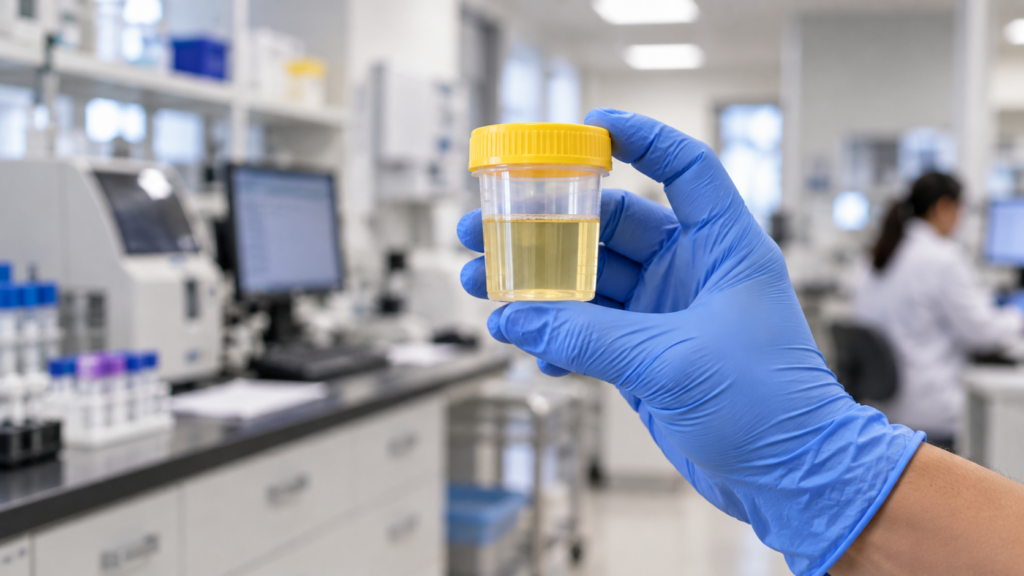
The phrase can LabCorp detect Quick Fix implies one machine on a bench looking specifically for synthetic urine. As you have hopefully gathered by now, the process does not work like that. An immunoassay screen looks for drug metabolites at set cutoffs and does not identify synthetic origin on its own. What it can do is flag anomalies in the validity markers.
GC-MS is a different instrument with a different job, profiling the chemical make-up of a sample with far greater precision, and a lab of LabCorp’s capability is fully able to run it. The question, however, is when.
A routine pre-employment screen that reads negative does not trigger it. It comes into play after a non-negative immunoassay result, or where confirmatory analysis is built in from the start, which is more typical of DOT-regulated, forensic or post-accident contexts than of standard hiring screens.
So, we might suggest that the sensible reader of this article clarifies what they have been asked to take, and under which regulatory framework, because that changes the risk profile more than the LabCorp name does. Either way, our guide to fake urine covers laboratory detection in more depth.
Interestingly enough, most people asking “will Quick Fix work at LabCorp” usually assume the answer lives in the formula. In reality, when a standard screen goes wrong, the cause is almost never formulation. It is temperature – the one variable sitting entirely with the user – so, for the purposes of this guide, we need to drill down on that a little.
There are two ways to bring the liquid up. Microwave the bottle in roughly 10-second bursts until the strip reads in range, or use the included Quick Fix heating pad, which takes about 45 to 60 minutes and holds the temperature for hours.
Always trust the strip: a reading in the green at 94°F to 99°F means you are in range. Then carry the bottle against your body to keep it warm, and take one final strip check before entering the collection room.

So, does Quick Fix work at LabCorp? While there is no honest way to guarantee what happens in any individual drug test, the answer is pretty simple, when reading between the lines.
LabCorp uses standard SAMHSA-certified immunoassay screening for routine pre-employment and occupational health tests, and Quick Fix 6.4 is formulated around the same specimen validity characteristics that method relies on, including creatinine, specific gravity, pH and urine-associated compounds.
The execution variable you actually control is temperature, which is why so much preparation advice circles back to it. And the LabCorp name counts for less than the type of test ordered, since a routine negative screen and a GC-MS confirmatory analysis are not the same procedure.
In any event, we would not suggest anyone should use Quick Fix to pass a test of this nature. The product was designed for research and novelty uses only, and if you are thinking of using it for a LabCorp test, you may be exposing yourself to legal issues.
For a broader idea of how the product works, our honest assessment of Quick Fix covers the finer points in more detail.
Yes. DOT-regulated collections follow stricter procedures under 49 CFR Part 40, including formal chain-of-custody rules and directly observed collection in specific circumstances such as certain return-to-duty and follow-up tests. Standard non-DOT pre-employment tests run under the employer’s own, often less rigid, policy.
Not directly. The screen is built to detect drugs and their metabolites at set cutoff concentrations, so it does not identify synthetic origin by itself. What it can do is flag anomalies in the validity markers, such as an out-of-range temperature or pH. Detailed chemical profiling of a sample’s composition is a GC-MS function.
A temperature reading outside the accepted range does not produce a positive result. It produces an invalid one. The usual consequence is a re-collection, which depending on the program may take place under direct observation. It is a specimen-validity issue rather than a drug-test result.
The laboratory analysis is the same, because the same certified lab runs it either way. What differs is the collection procedure and the chain-of-custody requirements around it. An employer-mandated workplace test follows a defined collection and custody process, whereas a clinical sample from a doctor’s office may be handled under different rules before it reaches the lab.
Disclaimer: This content is for informational and educational purposes only. Quick Fix Synthetic does not condone or encourage the use of our products to defraud legally mandated drug tests. Please consult your local and state laws before use.
 Blog
ONE OF THE MOST COMMON QUESTIONS WE RECEIVE HERE AT QUICK FIX: WHERE CAN I BUY A QUICK FIX SYNTHETIC IN A STORE NEAR ME?…
 Blog
How to use your Quick Fix urine Upon reading synthetic urine reviews and stories of how people went into the lab and delivered a synthetic…
 Blog
Gas chromatography-mass spectrometry is a means of analyzing samples to identify individual substances using the features of gas-liquid chromatography as well as mass spectrometry.…


