 Blog
Where Can I Buy Quick Fix Synthetic Urine?
ONE OF THE MOST COMMON QUESTIONS WE RECEIVE HERE AT QUICK FIX: WHERE CAN I BUY A QUICK FIX SYNTHETIC IN A STORE NEAR ME?…


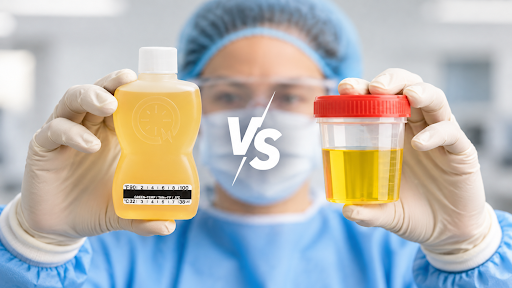
Given its popularity, it’s not unusual for people to ask whether Quick Fix actually works – and we have various articles covering that subject – but this article poses a slightly different question: how close is synthetic urine to the real thing, chemically speaking?
It’s a difficult question to answer conclusively, because you could argue Quick Fix and real urine are identical. By the same token, you could also argue there are striking differences.
When you compare Quick Fix 6.4 vs real urine and look at what each one is made of, you get two liquids that behave the same under a routine check, but also diverge sharply under a full laboratory analysis. And therein lies the difference.
Confused? Don’t worry – it will become quite clear as you read on. This guide explains those similarities and differences, including where they match and where they differ, covering exactly what levels of testing can and cannot see.

Real urine looks simple at first glance, but it is actually quite complicated. Again, chemically speaking. Consisting of roughly 95% water, the remaining 5% is a busy, messy, chemical soup.
In terms of the make up of real urine, urea leads the way as the body’s primary way of dumping nitrogen waste, before creatinine follows as a close second, which is a byproduct of ordinary muscle activity that labs lean on heavily as a sign a sample came from a living person.
Uric acid shows up from purine metabolism, and a spread of electrolytes such as sodium, potassium, and chloride ride along with it.
Now, past those familiar names, the sample gets unique, depending on the person. It carries hormones and hormone metabolites that shift by individual, day, and even hour. There are enzymes, trace proteins, vitamins and their breakdown products, and (when relevant), drug metabolites. Layered on top are biological identifiers that belong to one specific body and no other.
You can imagine, owing to that last part, why a decent synthetic urine formula takes real laboratory work to produce. Matching a handful of markers is achievable, but rebuilding the full biological fingerprint of a particular person is not, which is why kitchen-sink attempts at homemade fake urine fail the moment anyone checks them properly.

Quick Fix 6.4 is not trying to be a full biological replica. Let’s be clear about that before going any further.
It is engineered to satisfy the specific parameters a validity check inspects, and it covers them deliberately. Urea is present as the main validity marker. Uric acid is present too, which was a genuine step forward over older formulas that failed to include it. Creatinine is included and calibrated to sit inside the human range rather than floating somewhere a technician would identify.
The physical properties are included to match as well. The pH lands within the 4.5–8.5 window a real sample occupies, and the specific gravity holds inside 1.001–1.030. Then there is the part people forget: appearance. The formula produces a believable colour and, yes, the foam structure you would expect when the sample is handled, because a flat, lifeless liquid draws a second look.
One less obvious but important upgrade is under the hood, though. Earlier synthetic formulas relied on biocide preservatives, and labs eventually started treating those compounds as a tell, since human urine has no reason to contain them. Version 6.4, however, drops biocide entirely.
Set the two side by side and the pattern is quite striking. On every marker a routine check reads, the synthetic urine vs real urine gap closes to nothing. On the biological extras, real urine stands alone.
Read the two right-hand columns together and you will notice that everything a validity check tests for, Quick Fix 6.4 supplies. Everything it does not supply occupies the rows the validity check never reads.

For a standard immunoassay validity check, Quick Fix 6.4 answers everything the check asks, with the temperature first, then the five markers. Hormones, DNA, and personal biomarkers never come up, because immunoassay screening is not built to find them.
GC-MS testing is a different game, as it profiles a sample’s full chemistry and notices when compounds that should be in human urine are missing, and that absence is the difference a deep analysis can catch.
You might describe the comparison as a passport check versus fingerprinting: one confirms the format is right, the other verifies identity down to a level no forgery could possibly survive. The key here is that most workplace screening runs at the passport level.
So where does that leave the real urine vs synthetic urine question in layman’s terms? Essentially, Quick Fix 6.4 replicates the parameters a standard drug test validity check is designed to verify, and it does so with markers calibrated to human ranges rather than rough approximations.
That is the honest strength of the product, but we need to be clear about something: Quick Fix is made for laboratory research, calibration, and novelty use, not for beating a mandated drug test. Some people do put it to that use, but we certainly do not advocate it, and it is not what the product is designed for.
Either way, the equally honest limitation is that real urine is more chemically complex than any synthetic formula currently sold. It carries a biological signature that no manufacturer replicates in full. GC-MS can tell the two apart by reading that signature; a standard immunoassay screen cannot, because it was never designed to look.
For novelty and research purposes, you can find the latest version of Quick Fix 6.4 right here.
Yes, and it can. Real urine starts degrading soon after collection as bacteria multiply and the pH drifts, with noticeable chemical changes inside a few hours. Quick Fix 6.4, with its biocide-free preservation, stays chemically stable far longer than a stored real sample, so on the stability question the synthetic option holds up better over time.
Real urine carries sex-specific hormone metabolites; synthetic urine does not include them. GC-MS could in theory detect that absence, but a standard validity check does not test for sex-based biomarkers at all, so at the routine screening level the question never comes up.
The engineering is harder than it sounds. Every compound you add brings its own valid range, and stacking more of them raises the odds of landing outside one of those ranges and failing the check you were trying to pass. Spectrum Labs’ approach is to match the markers a validity check reads precisely, rather than chase a full biological copy and introduce new ways to slip out of range.
The headline change in 6.4 is biocide-free preservation, which removes one specific detection vector. Both versions carry the same core validity-check markers, so for a standard immunoassay context they address the same parameters. You can see the current Quick Fix 6.4 formula for the full specification.
Disclaimer: This content is for informational and educational purposes only. Quick Fix Synthetic does not condone or encourage the use of our products to defraud legally mandated drug tests. Please consult your local and state laws before use. While Quick Fix does closely replicate the composition of human urine, and while it is true that some people may use it for purposes other than those it was designed for, as discussed in this article, we do not advocate any such use. The product was not built for that purpose. Quick Fix is manufactured and sold strictly for novelty and research purposes only.
 Blog
ONE OF THE MOST COMMON QUESTIONS WE RECEIVE HERE AT QUICK FIX: WHERE CAN I BUY A QUICK FIX SYNTHETIC IN A STORE NEAR ME?…
 Blog
How to use your Quick Fix urine Upon reading synthetic urine reviews and stories of how people went into the lab and delivered a synthetic…
 Blog
Gas chromatography-mass spectrometry is a means of analyzing samples to identify individual substances using the features of gas-liquid chromatography as well as mass spectrometry.…


