 Blog
Blog
Where Can I Buy Quick Fix Synthetic Urine?
ONE OF THE MOST COMMON QUESTIONS WE RECEIVE HERE AT QUICK FIX: WHERE CAN I BUY A QUICK FIX SYNTHETIC IN A STORE NEAR ME?…


TL;DR: Concentra does not advertise or operate a dedicated synthetic urine detection test. What Concentra does do (in common with every other reputable collection provider) is follow standard specimen validity testing protocols that evaluate whether a urine sample behaves like genuine human urine. If the markers don’t add up, the sample gets flagged.
If you have recently been told to report to a Concentra clinic for a drug test, you are in considerable company. Concentra is one of the largest occupational health providers in the United States, with over 500 locations across the country and contracts with a staggering number of employers.
The question of whether Concentra tests for synthetic urine is, by search volume alone, one of the most asked questions in the entire drug testing space.
The internet, rather predictably, has not been especially helpful in answering this simple question. Forum responses range from the confidently wrong Concentra doesn’t test for anything, just hand it over and leave to the hysterically paranoid they have a machine that can tell if it’s synthetic within seconds.
Of course, neither is accurate. The truth, as usual, lies somewhere in the middle of those two extremes, and it is considerably more interesting than either one.
Explaining how the Concentra drug test works requires an important distinction that most articles on this subject fail to make: Concentra is primarily a collection facility, not a laboratory per se. The people at the clinic collect your sample, but they do not, for the most part, analyze it.
Concentra provides several types of drug testing depending on the employer’s requirements and the regulatory framework governing the role. These include urine testing (by far the most common), oral fluid (saliva) testing, hair follicle testing, and blood testing. The type of test administered is determined by the employer or the relevant regulatory body, not by Concentra itself.
For DOT-regulated positions (such as trucking, aviation, pipeline, transit, and maritime), urine testing is mandated by federal law. For non-DOT positions, the employer chooses. Most choose urine, because it is the cheapest, the most established, and the one that everyone involved is probably least uncomfortable with.
The urine collection process at Concentra follows the same protocols used across the industry. You present a valid photo ID, empty your pockets, leave personal belongings in a designated area, and provide a sample in a private restroom. A collector checks the temperature strip on the cup within four minutes, confirms it reads between 90°F and 100°F, and seals the specimen with tamper-evident labels.
The sample is then split into two bottles, with Bottle A the primary, and Bottle B the split, before being shipped to a SAMHSA-certified laboratory for analysis. This is where the actual science takes place; the initial screen uses immunoassay testing to detect the presence of drug metabolites, while specimen validity testing runs in parallel to confirm the sample is legitimate.
Concentra follows these protocols consistently. The collection is standardized, and the analysis is outsourced. The collector’s job is merely to handle the paperwork, check the urine temperature, and ship the specimen.
Everything else happens in a laboratory that most donors will probably never see.
The short answer is no, or certainly not in the way most people imagine when they ask the question.
There is no official statement from Concentra indicating that they operate any kind of proprietary synthetic urine detection system. Their published materials do not reference synthetic urine testing. User Q&A threads on sites like Indeed and Glassdoor (for whatever they are worth) consistently report that Concentra does not appear to specifically screen for synthetic urine as a distinct category.
But with that, a caveat applies: the absence of a branded fake urine detector does not mean your sample won’t be flagged.
The reason is simple. Concentra’s partner laboratories run specimen validity testing on every urine sample they receive. SVT evaluates whether the sample’s chemical profile is consistent with what genuine human urine looks like, including creatinine concentration, specific gravity, pH, and the presence or absence of adulterants. If those markers fall outside expected physiological ranges, the sample is flagged as substituted, adulterated, or invalid.
The lab does not need to know whether the sample came from a bottle labeled Quick Fix or a competitor product or a creative home experiment involving Mountain Dew. It simply needs to determine whether the chemical fingerprint looks human. If it does, the sample proceeds to drug panel analysis. If it doesn’t, the donor has a problem.
This is the clear and obvious distinction that internet posters seem to get so constantly wrong. The question is not whether Concentra tests for synthetic urine by name, but whether the laboratory that processes Concentra’s samples can identify a specimen that doesn’t behave like real urine.
The answer to that is a firm yes.

The validity checks that apply to Concentra drug test specimens are the same ones used across the entire workplace testing industry. They are not unique to Concentra, they are not optional, and they run on every single sample.
The first checkpoint happens at the clinic itself, before the sample ever reaches a laboratory. The collector reads the urine temperature strip within four minutes of collection. The acceptable range is 90°F to 100°F. A reading outside this window results in documentation on the Chain of Custody Form and, in most cases, an immediate recollection under direct observation.
Temperature is the single most common reason samples are rejected, and it has nothing to do with laboratories or chemistry. It is a three-second check that catches a remarkable number of people.
Once the sample reaches the laboratory, SVT evaluates the following:
When a sample fails one or more validity checks, the laboratory classifies it as either substituted, adulterated, or invalid, and reports the finding to the Medical Review Officer (MRO). The MRO then contacts the donor for a verification interview, during which the donor has an opportunity to provide a legitimate medical explanation.
If no credible explanation is forthcoming, the MRO reports the result. For substituted or adulterated findings, this is typically classified as a refusal to test, which, as you probably guessed, carries the same consequences as a confirmed positive. For invalid results, the outcome is usually a cancelled test and an immediate recollection, often under direct observation.
This is a slightly different question from whether Concentra tests for synthetic urine.
Can Concentra detect synthetic urine? There is no test that identifies a sample as Brand XYZ Synthetic Urine or anything else, for that matter. What the partner laboratory can detect is a sample whose chemical markers fall outside the ranges expected of genuine human urine.
If the creatinine is wrong, if the specific gravity is off, if the pH is abnormal, or if adulterants are present, the sample will be flagged regardless of what it actually is.
A well-formulated synthetic urine product (one that contains calibrated creatinine, urea, uric acid, balanced pH, and realistic specific gravity) can present markers within expected physiological ranges. Passing SVT means the sample was not flagged. It does not mean the lab certified it as human.
It is worth remembering that the industry is also evolving. Some laboratories now test for proprietary human biomarkers that go beyond standard SVT chemistry, and this trend is likely to continue.
Whether the specific labs that process Concentra’s samples currently employ these advanced panels is not publicly disclosed, but the direction of travel across the industry is definitely headed toward more sophisticated detection methods, in our opinion.
That said, as things stand at the moment, SVT remains the primary testing method, and a well-formulated synthetic urine product that hits the right markers will clear it without incident – not that we would recommend doing so, of course.
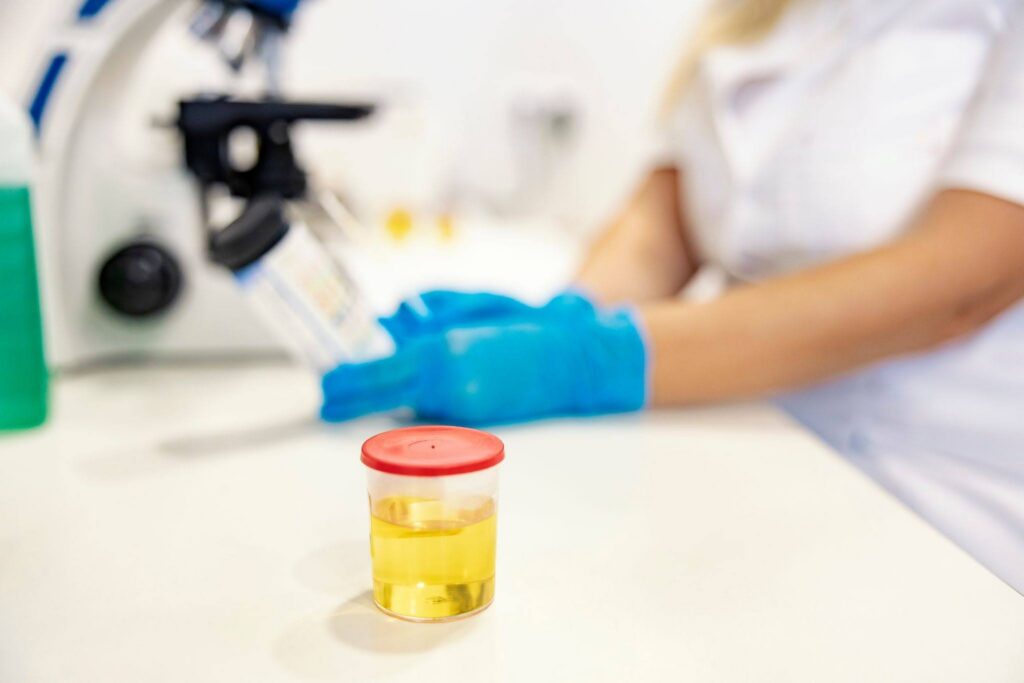
The consequences of a flagged sample follow a predictable escalation, regardless of whether the issue was temperature, chemistry, or both:
The process is the same whether the sample was synthetic, diluted, adulterated, or simply unlucky. The lab does not distinguish – a red flag is a red flag.
Does Concentra test for synthetic urine? In short, no. Or at least, not as a specific, named screen. There is no fake urine detector in the Concentra workflow.
Again, what Concentra’s partner laboratories do test for is whether a sample’s chemical profile including creatinine, specific gravity, pH, and adulterants, falls within the ranges expected of genuine human urine. This is specimen validity testing, it runs on every single sample without fail, and it is the mechanism by which synthetic, diluted, or tampered specimens are identified.
Disclaimer: This article is for informational and educational purposes only. It does not endorse tampering with or attempting to fraudulently pass drug tests. Always comply with applicable laws, employer policies, and testing regulations.
No, or at least, not specifically – Concentra does not advertise (or operate) a dedicated fake urine detection test. Their partner laboratories use specimen validity testing to evaluate whether a sample’s markers are consistent with genuine human urine, which is how abnormal specimens are identified.
Concentra’s partner labs can flag a sample whose chemical profile falls outside physiological norms. Whether a specific synthetic product is detected depends on how accurately it replicates human urine markers, including creatinine, specific gravity, pH, urea, and uric acid.
Concentra collects the sample at their clinic following standard protocols, including ID verification, private collection, temperature check, and chain of custody documentation. The sample is then shipped to a SAMHSA-certified laboratory for immunoassay drug screening and specimen validity testing.
Concentra is primarily a collection site. The actual urine laboratory analysis is performed by partner labs using the same SAMHSA-certified protocols as standalone laboratories like LabCorp or Quest Diagnostics. The testing standards are industry-wide, not Concentra-specific.
The laboratory classifies it as substituted, adulterated, or invalid. The MRO reviews the finding, contacts you for a verification interview, and (if no medical explanation is provided) reports the result as a refusal to test. Consequences vary by employer but can include rescinded offers, disciplinary action, or termination.
 Blog
Blog
ONE OF THE MOST COMMON QUESTIONS WE RECEIVE HERE AT QUICK FIX: WHERE CAN I BUY A QUICK FIX SYNTHETIC IN A STORE NEAR ME?…
 Blog
Blog
How to use your Quick Fix urine Upon reading synthetic urine reviews and stories of how people went into the lab and delivered a synthetic…
 Blog
Blog
Gas chromatography-mass spectrometry is a means of analyzing samples to identify individual substances using the features of gas-liquid chromatography as well as mass spectrometry.…


